A supplier outreach email template should do one job: make it easy for the right person at a brand, manufacturer, or distributor to decide whether your store is worth a conversation. It is not a place to pitch a dream, copy a generic “I love your products” paragraph, or ask for every possible document before the supplier knows who you are.
That matters in high-ticket dropshipping. Good suppliers are often managing dealer applications, existing retailers, inventory questions, freight issues, and brand standards at the same time. Your message does not need to be long. It needs to be specific, credible, and easy to route.
This guide gives you a practical structure for the first email, a responsible follow-up sequence, and the information to have ready before you ask for a wholesale or dealer conversation. Use the framework as a starting point, then make every message relevant to the company you are contacting.
Start outreach with a research-backed shortlist.
Supplier Paradise members can search high-ticket supplier, manufacturer, sourcing, and fulfillment research leads by category, company, supplier type, and reported markets served before they begin contacting companies.
What your first supplier email needs to accomplish
Think of the first email as a routing tool, not a full application. The supplier should be able to understand four things quickly:
- Who you are. Your name, business, site, and the role you play.
- What you are building. The category, customer, and sales channel you plan to serve.
- Why you are contacting this company. A relevant product line, category fit, or delivery capability, not a vague compliment.
- What you need next. The right dealer, wholesale, or ecommerce contact path, plus the application requirements.
That is enough for a first interaction. You do not need to explain your entire life story or pretend you already have a huge customer base. You do need to show that you understand the category well enough to ask useful questions.
Shopify’s supplier guidance notes that many suppliers outside marketplace apps expect a business application and proof that an applicant is legitimate. It also recommends looking for clear communication, support, efficient order processes, and written policies rather than relying on a catalog alone. Read Shopify’s supplier-selection guidance for the full context.
Prepare before you contact anyone
A polished email cannot compensate for a business that looks unfinished. Before outreach, make it easy for a supplier to validate the basics without going back and forth for a week.
Your storefront and positioning
Have a real website that makes the category and customer clear. It does not need thousands of products. It should have a professional domain, contact information, a clear point of view, basic policies, and an honest description of what you sell. If you plan to build a specialist store, your outreach should match that specialist positioning.
Your legal and operating details
Many suppliers will ask for business information, tax documentation, a resale certificate, insurance, or references. Requirements vary by company, category, and jurisdiction. Keep the documents you legitimately have organized, and ask each supplier what its current application requires. Do not fabricate a business history or claim you are authorized for channels that you have not been approved to use.
Your customer and channel plan
Know whether you are building a direct-to-consumer store, serving trade customers, selling through a physical showroom, working with designers, or using another model. Suppliers often have rules for marketplaces, paid advertising, territories, or product lines. A short, honest summary of your plan gives the account team something real to assess.
Your supplier questions
Research the company first. Look at its official catalog, dealer page, product family, shipping information, contact route, and any published policy. Then write three to five questions that would decide whether it belongs on your shortlist. The best outreach is prepared enough that the supplier does not have to teach you what it already published.
The core supplier outreach email template
Use this version when you have identified a legitimate possible fit but do not yet know the right dealer or wholesale contact. Replace the brackets with real information. Remove anything that is not true.
Subject: Dealer inquiry for [Brand or Company] [product category]
Hi [Name or team],
My name is [Your Name], and I run [Store Name], a [brief description of the customer and category you serve]. I am researching a focused [category] assortment for customers looking for [relevant buying outcome].
I came across [Company or specific collection] because [one specific, honest reason connected to its product, positioning, delivery capability, or category fit]. Before I take the next step, I wanted to ask whether you currently work with online retailers for [dealer / wholesale / direct-to-consumer dropship] fulfillment.
If there is a fit, could you point me to the correct application or contact and let me know the current requirements for:
• dealer or reseller approval
• product-line and channel availability
• fulfillment and shipping process
• MAP or marketplace restrictions, if applicable
I am happy to send the appropriate business details and a link to the store. Thank you for your time.
Best,
[Your Name]
[Store Name]
[Website]
[Phone, if appropriate]
The template is intentionally simple. It gives a busy account manager enough context to decide whether to reply, forward the message, or send an application. It does not promise sales volume you cannot support or make claims about a partnership that does not exist.
How to tailor it for each supplier type
For a brand or manufacturer
Show that you understand the product and the kind of buyer it serves. Ask whether the brand supports online dealers, which collections are eligible, and what it expects from a retailer representing its products. Brands may care deeply about MAP, image quality, customer experience, showroom requirements, marketplace restrictions, and how their name appears online.
A useful line might be: “We are building a focused [category] store for [buyer], and your [collection] stood out because [specific reason]. Do you currently approve online retailers for this product line, and what does the dealer application require?”
For a distributor
Be clear that you understand a distributor may represent several brands with different rules. Ask how it handles new dealer onboarding, which lines are available to an online retailer, whether direct-to-customer fulfillment is available, and where the current policy lives. Do not assume one account grants permission for every product in the catalog.
For a manufacturer with a complex freight model
For furniture, outdoor products, commercial equipment, saunas, or other oversized goods, mention the delivery questions early. You are not asking for a freight quote in the first email. You are asking whether the supplier’s fulfillment model can support the customer experience you want to offer. Confirm the details later in writing.
Questions worth asking after the supplier responds
Once a supplier opens the conversation, move from general fit to operational fit. The exact questions change by category, but a strong next step usually covers:
- Which products or brands are available to a new account?
- What business documentation and approval steps are required?
- Does the company fulfill orders directly to end customers, and from where?
- How are stock availability, lead times, tracking, and backorders communicated?
- What delivery levels, freight charges, or service constraints apply?
- What MAP, marketplace, territory, or paid-ad restrictions apply?
- Who owns product-data updates, damaged deliveries, returns, and warranty communication?
Use the Supplier RFQ Template when you need comparable answers across several viable companies. Then use the Supplier Comparison Scorecard to put the answers beside each other instead of relying on memory.
Do not make the email do the work of due diligence.
A responsive answer is a promising signal, not an approval or a commercial guarantee. Keep the written terms, application, shipping process, and policy confirmation with the supplier record before you list products.
A simple two-follow-up sequence
Follow up because inboxes are busy, not because you are trying to pressure a stranger. Each follow-up should make it easy for the recipient to say yes, point you to the right person, or tell you the program is not currently available.
Follow-up one: five to seven business days later
Subject: Re: dealer inquiry for [Company]
Hi [Name or team],
Just following up on my note below in case it reached the wrong inbox. I am researching a focused [category] store and would appreciate being pointed to the right contact or application path for [dealer / wholesale / online retailer] inquiries.
If the program is not a fit or is not currently open, no problem at all. A quick direction would help me close the loop.
Thank you,
[Your Name]
Follow-up two: seven to ten business days after that
Subject: Closing the loop on [Company] dealer inquiry
Hi [Name or team],
I wanted to close the loop on my earlier inquiry. If there is a current dealer or ecommerce application path for [Company], I would be grateful for the right contact or link. Otherwise, I will take this off my active research list for now.
Thanks again for your time,
[Your Name]
After that, stop. A short, respectful sequence protects your brand better than a string of “just checking in” messages. Keep a note of the date, the recipient, the outcome, and the next action. If a supplier says it is not currently onboarding retailers, honor the answer.
What not to say in supplier outreach
“I can get you a lot of sales”
Maybe you will, but that is not evidence at the application stage. Suppliers hear this all the time. Explain the customer and category you intend to serve, then let your site, preparation, and follow-through demonstrate that you are serious.
“Can you send your full catalog and wholesale pricing?”
That request gives the recipient little reason to invest in you. Start with the correct account path. Once you qualify, ask for the documents and product data relevant to the approved relationship.
“I am a big fan of your brand” with no detail
A generic compliment is easy to spot. Mention a legitimate product, customer problem, or brand position that connects to your store. If you cannot name one, spend ten more minutes researching before you press send.
Anything misleading about your business or channel
Do not hide a marketplace plan when the supplier asks about channels. Do not claim you are already approved, established, insured, or selling volume you do not have. High-ticket supplier relationships are easier to maintain when the foundation is honest.
Keep the outreach process organized
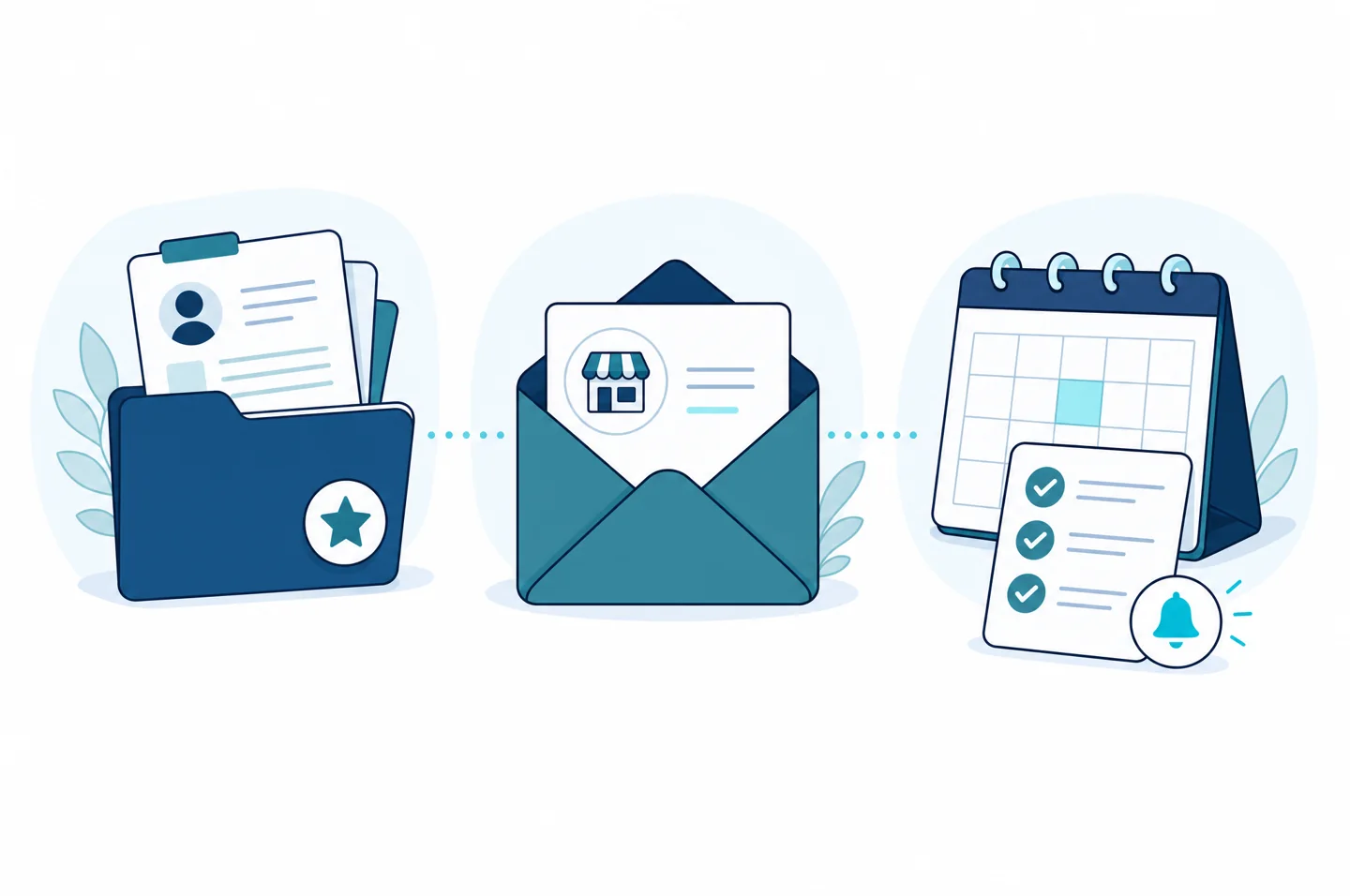
A simple supplier pipeline can prevent a lot of wasted work. Track the company name, website, category, source of the lead, contact route, status, last contact date, response, requested documents, terms to verify, and next action. Separate “research lead,” “contacted,” “application in progress,” “approved,” “not a fit,” and “revisit later.”
That distinction matters. A company appearing in your research does not mean it has approved your store. A positive reply does not mean it supports every product or shipping route. A supplier account does not mean you can advertise every collection in every channel. The record helps you keep the commercial reality clear.
Shopify’s supplier-management guidance also stresses keeping supplier details and purchasing information organized, including communication and payment terms. See Shopify’s supplier-management documentation for a useful operational reference.
Email responsibly
This guide is about relevant one-to-one business outreach, not blasting the same promotion to a purchased list. Use an accurate sender identity, relevant subject line, and a real reply path. If you later run broader commercial email campaigns, understand the rules that apply to your recipients and location. The Federal Trade Commission’s CAN-SPAM materials are a useful starting point for U.S. commercial email requirements. Review the FTC’s CAN-SPAM compliance guide.
Five checks before you press send
- Check the company’s official site first. Make sure the product category, contact route, and program you mention are still current. A detail from an old directory or search result is not enough.
- Use the right contact. A generic contact form can be a reasonable start, but use a dealer, trade, wholesale, or business-development route if the company publishes one. Do not copy every address you can find into one message.
- Make the first paragraph specific. Name the relevant collection, customer problem, or delivery capability. If the message could be sent to one hundred companies unchanged, it needs more research.
- Confirm every claim about your own business. Your website, business name, category focus, and sales-channel description should match what the supplier will see when it clicks through. Truthful clarity is more useful than inflated social proof.
- Decide what a useful reply looks like. For most first messages, that is a correct application link, the right account contact, or a clear “not a fit.” This keeps the request easy to answer and makes your next step obvious.
A little preparation here compounds. It improves reply quality, makes your follow-up notes cleaner, and reduces the temptation to build product pages around suppliers that never approved the relationship in the first place.
Frequently asked questions about supplier outreach
How long should a supplier outreach email be?
Usually a few short paragraphs. Include enough context to show relevance and ask for the next correct step. Save product-level, freight, pricing, and policy detail for the conversation once a supplier confirms there may be a fit.
Should I contact suppliers before my store is finished?
You can research and ask about the current application path while a store is being built. Before you submit a formal dealer application, make sure the site and operating basics are ready enough for the supplier to review. Requirements differ, so ask directly.
How many suppliers should I contact at once?
Contact a focused batch that you can research and follow up with properly. Ten thoughtful messages with clear records are more useful than one hundred generic requests that create confusion and duplicate follow-up.
What if a supplier does not reply?
Send the short follow-up sequence, make sure you used the right contact route, and then move on. Non-response can reflect timing, a closed program, a misrouted email, or a lack of fit. It is not a reason to make bigger claims or send repeated pressure messages.
Start with relevant research, then earn the conversation
The best supplier outreach is not clever copy. It is a clear message from a prepared retailer who understands the product category, respects the supplier’s time, and wants to build an honest commercial relationship.
Research the company. Ask the right questions. Keep the answers organized. Then apply only when the relationship and operating model actually fit the store you want to build.
Make outreach more focused
Find relevant high-ticket supplier research leads before you begin the application process.
Supplier Paradise is built to reduce the blank-search-page stage, while keeping approval, pricing, inventory, shipping, and commercial terms where they belong: with each supplier.
Important: Supplier Paradise provides research leads and education, not supplier approval or commercial guarantees. Verify eligibility, product access, pricing, fulfillment, and policy terms directly with each supplier.
For a broader distributor discovery starting point, use our 10 high-ticket dropshipping suppliers to research, then apply this guide to the companies that fit your store.

Trevor Fenner is the founder of Ecommerce Paradise and writes about high-ticket dropshipping, supplier research, and building niche ecommerce stores. His Supplier Paradise guides help you compare suppliers, prepare dealer applications, and check shipping, returns, and warranty policies before you commit. Start with the supplier research guides and build a shortlist you can verify.
Join the Ecommerce Paradise community and follow Ecommerce Paradise on LinkedIn.